By: Morris Beegle
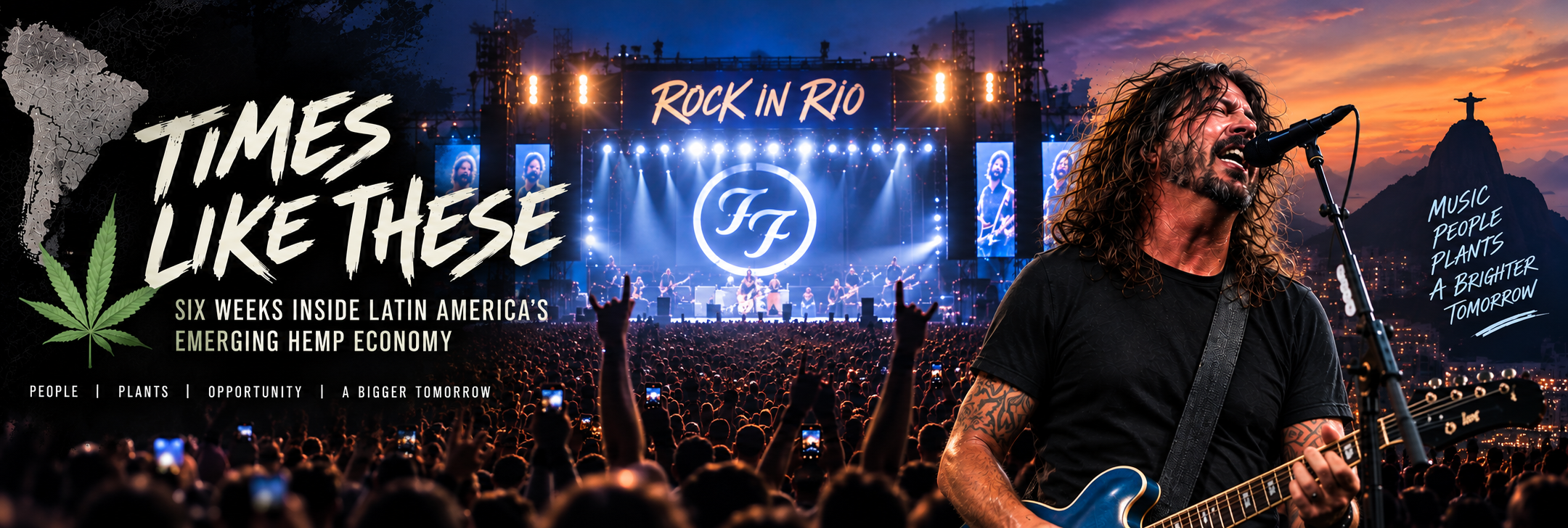
There are probably easier places to think about the future of industrial hemp than standing in the middle of Rock in Rio waiting for the Foo Fighters.
But after six weeks moving through Argentina, Peru, Uruguay and Brazil, meeting with farmers, entrepreneurs, researchers, regulators, textile companies, food companies and a collection of people stubborn enough to keep pushing this industry forward, it somehow made perfect sense.
Then the lights went down.
The crowd erupted. The guitars kicked in. And one of the world’s great surviving rock bands did what great bands do.
They played together.
That may sound like a strange way to begin a story about industrial hemp.
But stay with me.
Because somewhere during those six weeks, I started thinking less about individual hemp companies, countries and projects.
I started thinking about the band.
Six Weeks Earlier
I came to Latin America looking at industrial hemp through several different lenses: market development, international trade, agriculture, processing, policy and investment.
Much of the trip grew out of the international market-development work I’ve been doing through Bio-Smart Group and with the National Industrial Hemp Council in the U.S.
The objective wasn’t to sell Latin America a prepackaged American hemp model.
It was to listen.
To understand what already exists.
To identify where the gaps are.
And to see where relationships between Latin America, North America, Europe and other markets might actually lead somewhere.
I also came down here thinking I had a reasonably good idea of what I was going to find.
Naturally, that lasted about five minutes.
There is no single “Latin American hemp industry.”
Argentina isn’t Peru. Peru isn’t Uruguay. Uruguay certainly isn’t Brazil. The politics are different. Regulations are different. Agriculture is different. Manufacturing is different. Capital is different. And hemp itself means different things depending on who you’re sitting across the table from.
That’s what made the trip interesting.
There wasn’t one big revelation.
There were dozens of smaller ones.
A conversation over coffee. Walking through an industrial property. Sitting across from a government official who actually understands the crop. Meeting a textile manufacturer already producing for global markets. Talking with somebody about grain instead of cannabinoids. Seeing fiber stacked in a warehouse. Hearing somebody describe a problem in one country and realizing I’d just met someone in another who might help solve it.
Back and forth.
Country to country.
Person to person.
That’s how real industries start taking shape.
Argentina: Where Things Got Real
Argentina was where this trip really began.
I spent considerable time in Buenos Aires and Luján, including at the historic Steverlynck industrial campus, where there is an increasingly interesting collection of people and businesses working around agriculture, seed, genetics, fiber, food, processing and materials.
The history of the place is part of the story.
This isn’t a warehouse somebody rented last Tuesday and slapped a hemp banner on.
The Steverlynck campus comes out of Argentina’s textile and industrial history. Today, companies including LINERA, Ananda Pampa and Davis Farms Argentina are trying to figure out what the next version of that story might look like.
There is already hemp being grown. Seed multiplication is underway. Fiber has been harvested. Processing is being developed. Other manufacturers operate on the campus.
That’s when hemp starts getting interesting to me.
Not when somebody plants it.
When somebody has an idea what to do with it afterward.
I also spent time with Maximiliano Baranoff of IHS Grupo, someone I’ve known through the international hemp world whose work and relationships reach well beyond Argentina, across South America, Europe and North America.
Maxi thinks globally, beyond one crop and one harvest. Our conversations ranged from grain and food ingredients to genetics, regional production, international trade and where Latin America can fit into a much larger global supply chain.
For years, hemp has had a tendency to begin with production:
How many acres can we plant?
Wrong first question.
Who needs the product?
What specifications do they need?
At what volume?
At what price?
Then figure out where and how to grow it.
That sounds painfully obvious. The hemp industry has nevertheless spent a remarkable amount of time learning it.
Argentina has real agricultural capabilities, infrastructure and people doing the work. I left excited about what could happen there.
At that point, I probably would have told you Argentina was the place in Latin America I was most bullish about.
Then I kept traveling.
Peru: Stop Thinking Like a Hemp Company
Peru changed the conversation again.
I spent time with Raúl Injoque and José Ignacio Escalante of Futura Farms, two people who have been pushing the industrial hemp conversation in Peru for years, along with meetings involving government, agriculture and the country’s substantial textile sector.
Raúl and José have been working on this long enough to understand both the opportunity and the frustration.
Peru has agricultural capability, textile manufacturing, food production and access to international markets.
What it hasn’t had is a clear path for industrial hemp to participate in all of them.
And that kept bringing me back to a question that surfaced throughout the trip.
What if we’re asking the wrong question?
The question isn’t simply whether Peru can grow hemp.
Peru can grow things.
Lots of countries can grow hemp.
The more interesting question is what Peru can make from it.
Textiles immediately come to mind. Peru has a deep textile tradition, established mills and companies already manufacturing for international brands.
Then there is food.
Ingredients.
Animal nutrition.
Regional trade.
Suddenly hemp isn’t the industry.
Hemp is an input into industries that already exist.
That’s a very different way to look at the opportunity.
Maybe one of our industry’s biggest problems over the past decade has been thinking like hemp companies instead of thinking like food companies, textile companies, building-material companies, paper companies or automotive suppliers.
Those companies don’t wake up in the morning asking how they can help hemp.
Nor should they.
They have problems to solve.
If hemp solves one of them better, cheaper, cleaner or more reliably than the material they’re using now, we have a market.
If it doesn’t, we don’t.
Something for nothing isn’t much of a business strategy.
Uruguay: Small Country, Serious People
Uruguay may have been the biggest surprise of the trip.
We had an excellent meeting with Ing. Agr. Sergio Vázquez Barrios of DGSA-MGAP, along with Manuel Perez Basso of Com Senso, Andrés Sosa and Rodrigo Gómez of Goland Hemp Food, and Santiago Lezica of Ananda Pampa.
It was one of those meetings where you quickly realize nobody needs the Hemp 101 presentation.
Thank God.
We were talking with people dealing with the actual issues: regulation, agriculture, fiber, food, processing, commercialization and regional opportunities.
Sergio brings the government and regulatory perspective.
Goland is building around hemp foods.
Com Senso is focused on fiber.
Santiago brings experience from Argentina and Ananda Pampa.
That combination made the conversation useful because nobody was pretending that one part of the value chain could operate by itself.
And Uruguay punched well above its weight.
Small countries can sometimes move differently than large ones. Relationships are closer. Decision makers are accessible. Problems can be discussed in the same room by people who actually have the ability to do something about them.
I came away thinking Uruguay has a legitimate role to play in the regional story.
Maybe not because it will grow the most hemp.
Maybe not because it will build the biggest processing plants.
But because it has knowledgeable people who have already been doing the work.
That counts for a lot.
But Here We Are: Brazil
Then I got to Brazil.
And my perspective shifted again.
I’d met Marcelo S. Fernandes of Ayraa a few months earlier at the EIHA Conference in Poland. I liked him immediately. Smart, curious, connected, and working across several parts of the hemp opportunity rather than trying to force everything into one narrow box.
We reconnected in São Paulo.
That meeting also brought together Lorenzo Rolim, founder of LAIHA, and Bruno Agnello Pegoraro of Instituto Ficus, somebody I had specifically wanted to meet.
Bruno has been involved in important Brazilian research around industrial hemp, including work examining the science and agronomic realities behind hemp regulation in Brazil.
That’s exactly the kind of work this industry needs.
Science first.
Regulation based on actual growing conditions.
Then policy.
Instead of picking an arbitrary number somewhere else in the world and treating it as if Moses carried it down from the mountain.
I also met Renata Lima of QueenCo and Agritêxtil Regenerativo Restauro, a researcher and regenerative-agriculture enthusiast exploring how natural fibers can become part of better agricultural systems and new industrial applications.
By the time I left those conversations, I was seeing the regional picture differently.
Not because of anything I’d seen in Argentina, Peru or Uruguay.
If anything, Brazil reinforced something that had been developing throughout the trip: each country brings a different combination of people, capabilities, resources and opportunities to the table.
What excited me in São Paulo was the mix coming together around agriculture, research, policy, materials and market development.
Brazil has scale that is difficult to ignore.
Massive agriculture.
A huge domestic market.
Manufacturing.
Textiles.
Automotive.
Construction.
Research institutions.
Materials companies.
Capital.
And some very capable people beginning to find each other.
I want to see what this group looks like 12 to 18 months from now.
Not in isolation, but as part of a much larger Latin American picture.
Because the more countries I visited, the less I believed any one of them was going to build this industry alone.
The Feast and the Famine
I’ve been around industrial hemp long enough to watch this industry go through both.
There were years when seemingly everybody wanted in.
Money poured into CBD.
Companies raised millions.
Conferences exploded.
People who had discovered hemp eleven minutes earlier became experts on LinkedIn.
Then reality arrived.
Markets contracted.
Companies disappeared.
Farmers lost money.
Processors went under.
Investors headed for the exits.
Policy remained messy.
Turns out building industries is harder than making pitch decks.
Who knew?
But here’s the other thing I’ve learned.
Some people stayed.
People in North America, Europe, Australia and Asia who have been working on hemp for 10, 15, 20 or 30 years.
And now I’m meeting another generation of people trying to establish industrial hemp across South America.
Some will succeed.
Some won’t.
Some projects that look promising today will be DOA.
Others will come alive in ways nobody expects.
That’s normal.
That’s industry.
The mistake is confusing volatility with failure.
Agriculture takes time.
Infrastructure takes time.
Policy takes time.
Markets take time.
Relationships definitely take time.
And six weeks traveling through Latin America reminded me there is no shortcut around any of it.
Nobody Needs Another Hemp Revolution
We’ve had enough revolutions.
The hemp revolution.
The CBD revolution.
The green rush.
The next billion-dollar crop.
The plant that will save the planet.
I’ve used some of those phrases myself over the years.
We were all younger once.
But industrial hemp doesn’t need another revolution.
It needs customers.
It needs reliable genetics.
It needs farmers who can make money.
It needs processors who can run enough material through their equipment to stay in business.
It needs products that compete on performance and price.
It needs regulators who understand agriculture.
It needs trade.
It needs finance.
It needs boring things.
Lots and lots of boring things.
That’s how you know something is becoming an industry.
A Matter of Time
And that brings me back to Rio.
On September 4, at the end of nearly six weeks in Latin America, I went to Rock in Rio to see the Foo Fighters.
They’ve been doing this for more than three decades.
Think about what the music business has gone through during that time.
Formats disappeared.
Record stores disappeared.
Streaming changed everything.
Musical trends came and went.
Audiences changed.
Technology changed.
The economics changed.
The band itself went through enormous success and unimaginable loss.
But here they are.
Still playing.
Still relevant.
Still filling enormous venues.
There’s something about that I couldn’t shake after spending six weeks thinking about another industry that’s had its share of hype, setbacks, reinvention and people walking away.
The people who stay are usually the ones who end up building the industry.
But staying isn’t enough.
You have to adapt.
You have to know when to turn up the volume and when to listen to the rest of the band.
Times Like These
A great band isn’t one person playing louder than everyone else.
There’s the singer.
Guitars.
Bass.
Drums.
Production.
Sound.
Lighting.
Road crews.
Promoters.
Venues.
And eventually an audience that decides whether it wants to show up.
Take away enough pieces and you don’t have much of a show.
Industries aren’t that different.
Argentina doesn’t need to do everything.
Neither does Peru.
Neither does Uruguay.
Neither does Brazil.
And those are only the countries I was able to spend time in on this trip.
Colombia, Paraguay, Ecuador, Mexico, Guatemala and others could all become part of this story. Some are further along than others. Some already have hemp regulations or businesses operating. Others are still working through policy, market development and figuring out where they fit.
I didn’t visit those countries this time, so I’m not going to pretend I can tell you what’s happening there from the ground.
But I wouldn’t leave them off the map.
Latin America is too large, too agriculturally diverse and too connected to global trade to think the future will be built in four countries.
There may be genetics developed in one place, seed multiplied in another, fiber grown somewhere else, textiles manufactured in Peru, food ingredients processed in the Southern Cone, materials developed in Brazil, technology imported from Europe, investment from North America and customers in Asia.
Back and forth.
That’s not a weakness.
That might be the opportunity.
The future of industrial hemp in Latin America probably won’t be one giant vertically integrated company controlling everything from seed to shelf.
We’ve watched that movie before.
It didn’t end particularly well.
Maybe the better model is a network of people who are exceptionally good at their piece of the puzzle and understand that they need everyone else.
Part of my work over these six weeks was simply getting people into the same conversation.
A company in one country may have exactly what someone in another needs.
A researcher may have already worked through the problem an entrepreneur is encountering elsewhere.
A market in Europe or North America may create an opportunity for a producer in South America.
That’s where organizations like Bio-Smart Group and NIHC can be useful.
Not by trying to own the market, but by helping connect it.
Six weeks isn’t enough time to declare victory.
It is enough time to recognize momentum.
And I felt it.
In Buenos Aires.
In Luján.
In Lima.
In Montevideo.
In São Paulo.
And finally, standing in a sea of people in Rio de Janeiro listening to a band that’s managed to keep going for more than 30 years.
By the time I reached Rio, my view of Latin America had changed.
There is still plenty of work ahead.
There will be setbacks.
There will be policy fights, financing problems, failed crops, equipment that doesn’t work the way the brochure promised and people who decide this industry is harder than they thought.
There always are.
But there are also smart people showing up.
Researchers.
Farmers.
Regulators.
Entrepreneurs.
Manufacturers.
People who have been doing this for years and people bringing completely different skills into the room.
The players are here.
They’re starting to find one another.
They’re figuring out who does what.
And they’re beginning to play together.
For industrial hemp in Latin America, these are times like these.
And the band is just getting started.
