By RootSource Media,
The New Natural Economy Series
This article is the first installment in an ongoing RootSource Media series exploring the emerging bioeconomy and the growing role of renewable biological resources in agriculture, manufacturing, food systems, materials, energy, and global commerce.
From Hemp and Mycelium to Flax, Bamboo, Agricultural Residues, and Regenerative Agriculture, the Next Industrial Revolution Will Be Grown, Not Extracted
Walk through almost any store today and you’ll find products made from oil.
The packaging. The synthetic fibers. The foams. The coatings. The adhesives. The plastics hidden inside electronics, automobiles, building materials, and countless consumer goods.
For more than a century, fossil carbon has been the foundation of the global economy. It fueled unprecedented industrial growth, transformed transportation, and enabled the creation of modern manufacturing systems that touch nearly every aspect of our lives.
Yet alongside these advancements came a growing realization that extracting finite resources from the earth comes with consequences. Environmental degradation, waste accumulation, supply chain vulnerabilities, and economic uncertainty have prompted a new generation of innovators to ask an important question:
What if more of the products we use every day could be grown instead of extracted?
Around the world, farmers, researchers, entrepreneurs, manufacturers, Indigenous leaders, and policymakers are exploring that question. Their work spans agriculture, construction, packaging, textiles, food systems, energy, biomaterials, and biotechnology. While the sectors may appear unrelated on the surface, they are increasingly connected by a common idea.
Nature itself may provide many of the raw materials needed to build a more resilient future.
A new natural economy is beginning to emerge.
Nature’s Original Manufacturing System
Long before factories, supply chains, and industrial parks existed, nature was already operating the most sophisticated manufacturing system on Earth.
Plants capture sunlight, carbon dioxide, water, and minerals and transform them into fibers, proteins, oils, sugars, cellulose, medicines, and countless other compounds. Fungi recycle nutrients, build soil, decompose organic matter, and create entirely new biological structures.
Every field of hemp. Every stand of bamboo. Every flax crop. Every mushroom network beneath a forest floor.
These are biological systems continuously converting sunlight into useful materials.
The difference today is not that nature has changed.
The difference is that our understanding of what nature can provide is expanding.
Advances in material science, processing technology, agriculture, engineering, and manufacturing are allowing industries to revisit biological resources with fresh eyes. What was once considered old-fashioned, low-tech, or niche is increasingly becoming the focus of serious investment and innovation.
In many ways, we are rediscovering tools that have been in front of us all along.
The Waste We Forgot to Value
One of the most interesting developments within the emerging bioeconomy is the changing relationship between waste and value.
For generations, agricultural residues were often viewed as a disposal challenge. Farmers burned crop residues, buried them, left them in fields, or paid to haul them away.
Yet materials such as wheat straw, rice husks, corn stover, sugarcane bagasse, coconut coir, pineapple leaves, agave fiber waste, forestry residuals, and hemp stalks contain valuable fibers, cellulose, lignin, sugars, proteins, and other compounds that can serve as feedstocks for new products.
What was once considered waste increasingly looks like opportunity.
Across the world, companies are developing ways to transform these materials into textiles, building products, packaging, composites, biochemicals, animal bedding, paper, and a growing list of industrial applications.
The shift may seem subtle, but it represents a fundamental change in thinking.
Instead of asking how to dispose of agricultural byproducts, innovators are asking how to create value from them.
Agriculture and Industry Begin to Meet Again
For much of the last century, farming and manufacturing drifted into separate worlds.
Farmers produced commodities.
Factories produced products.
Today those lines are beginning to blur.
Modern agriculture is increasingly connected to industries that extend far beyond food production. Farmers now supply feedstocks for textiles, construction materials, biofuels, nutraceuticals, renewable chemicals, carbon products, and advanced manufacturing.
The concept of the biorefinery is becoming central to this transition.
Much like petroleum refineries learned to maximize value from every barrel of oil, biorefineries seek to maximize value from every harvest. Fiber, grain, oils, resins, proteins, sugars, cellulose, lignin, and other compounds can often be separated, refined, and directed into multiple markets.
This approach creates opportunities for farmers, processors, manufacturers, and rural communities alike.
It also encourages a more efficient use of biological resources, ensuring that more of what is grown finds productive use.
Beyond a Single Crop
Industrial hemp has become one of the most recognizable symbols of the emerging bioeconomy, and for good reason.
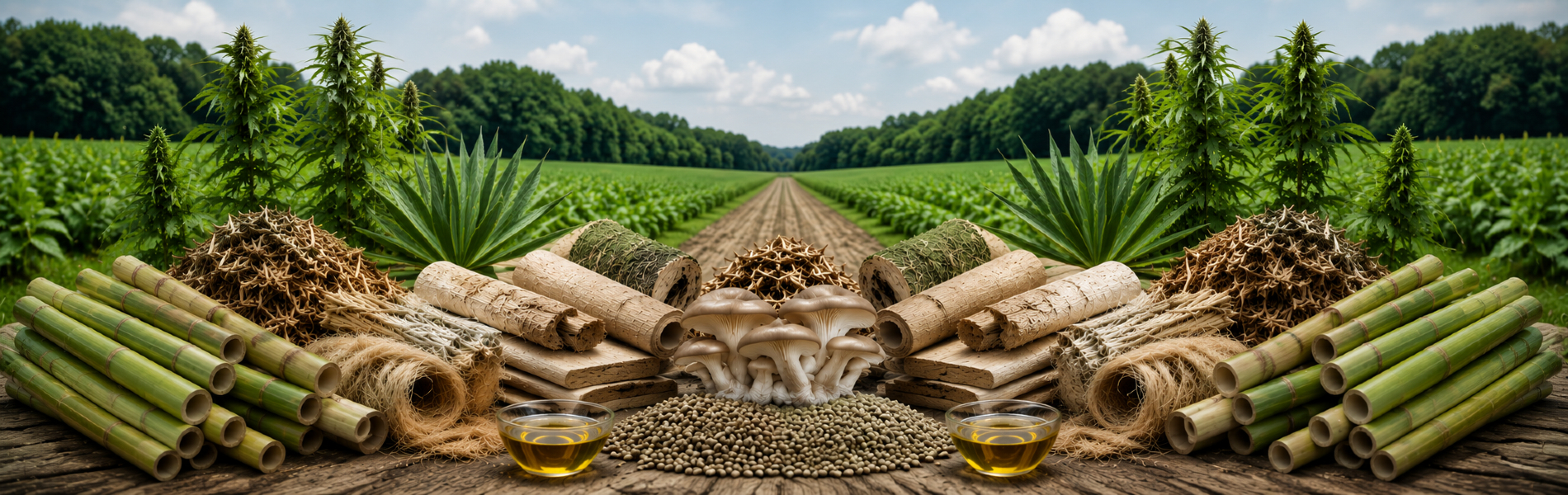
Few crops offer the versatility of hemp. Fiber for textiles, composites, pulps and advanced applications. Hurd for building and construction materials. Grain for food and feed products. Oils, proteins, cellulose, chemicals, and resin-rich floral material that supports medicinal, wellness, and specialty product markets.
However, hemp is only one chapter in a much larger story.
Flax continues to provide high-performance natural fibers. Bamboo is being utilized in textiles and construction products. Coconut fiber supports horticulture and industrial applications. Agricultural residues are entering packaging and materials markets. Mushrooms and mycelium are opening entirely new pathways for food, packaging, remediation, and biomaterials.
The future natural economy will not be built around a single crop.
It will be built around a diverse portfolio of biological resources working together across regions, climates, and industries.
No single solution will replace every petroleum-derived material.
But collectively, biological systems offer an expanding toolbox capable of addressing challenges across multiple sectors.
Learning from the Past While Building the Future
Despite the advanced technologies driving many of today’s innovations, some of the most important lessons come from knowledge that predates modern industry.
Indigenous communities and traditional agricultural societies have long understood the importance of stewardship, soil health, biodiversity, and working within natural systems.
Healthy soils produce healthier crops.
Healthy ecosystems are more resilient.
Resources are most valuable when managed with a long-term perspective.
These principles are increasingly finding their way into discussions around regenerative agriculture, ecosystem restoration, and sustainable resource management.
The future bioeconomy will not be built solely through technology.
It will also depend on wisdom, observation, and an understanding that human prosperity remains connected to the health of the natural systems that support us.
A Broader Cultural Shift
The conversation around soil health, regenerative agriculture, and biological systems has moved far beyond farming circles.
Increasingly, consumers, investors, corporations, and governments are paying closer attention to where products come from, how they are made, and the impacts they have throughout their lifecycle.
This month marks the release of Groundswell, the latest film from the team behind Kiss the Ground and Common Ground. Together, these films have helped bring conversations about soil health, agriculture, climate resilience, and food systems into mainstream awareness.
Whether viewed through the lens of farming, forestry, biomaterials, food production, or rural economic development, a common theme continues to emerge.
Healthy biological systems create value far beyond the farm gate.
The growing public interest in regenerative agriculture reflects something larger than farming practices alone. It reflects a renewed appreciation for the interconnected relationships between land, resources, communities, and economies.
A Global Movement Taking Shape
The New Natural Economy is not confined to one country or one industry.
Meanwhile, across Europe, investment continues in hemp fiber processing, bio-based materials, and circular manufacturing systems.
In North America, entrepreneurs are exploring new markets for natural fibers, grain products, regenerative agriculture, and biobased construction materials.
Across Latin America, Africa, and Asia, abundant agricultural resources and emerging processing infrastructure are creating new opportunities to participate in the global bioeconomy.
From hemp processing facilities in France and the Netherlands to bamboo innovation in Asia, agave fiber applications in Mexico, regenerative farming initiatives across the Americas, and mycelium-based technologies emerging worldwide, the building blocks are already being assembled.
Even so, many of these efforts remain small compared to established industries.
But every major industry starts somewhere.
Looking Ahead
At RootSource Media, we believe many of the most important stories of the coming decades will emerge at the intersection of agriculture, biology, manufacturing, stewardship, and innovation.
The New Natural Economy is not about returning to the past.
It is about carrying forward the best of what we have learned while rebuilding a closer relationship with the biological systems that make life possible.
The future bioeconomy will not be built by a single crop, company, country, or technology.
It will be built through collaboration.
The raw materials already exist.
They are growing in fields, forests, farms, grasslands, wetlands, and agricultural landscapes around the world.
The tools continue to improve.
The knowledge continues to expand.
The momentum continues to build.
The question is no longer whether a natural economy is possible.
The question is how quickly we choose to build it.
One field at a time.
One harvest at a time.
One innovation at a time.
The next industrial revolution will not be mined, drilled, or extracted.
It will be grown.
