By: RootSource Media,
The New Natural Economy Series | Part 2
In this ongoing RootSource Media series, we explore the people, industries, technologies, and market forces shaping the emerging bioeconomy.
Part 1: The New Natural Economy
Part 2: Agriculture Becomes Manufacturing
From Commodity Crops to Multi-Product Biorefineries, Farmers Are Becoming the First Link in a New Industrial System
For generations, agriculture has largely operated on a simple model.
Grow a crop. Harvest it. Sell it as a commodity.
Corn becomes feed, ethanol, or food ingredients. Wheat becomes flour. Cotton becomes textiles. Farmers are typically paid based on the volume of a primary product, while much of the additional value is captured further down the supply chain.
That system helped build modern agriculture, but it also created challenges. Commodity markets can be volatile. Weather remains unpredictable. Input costs continue to rise. Meanwhile, many rural communities have struggled to capture the full economic benefit of the resources they produce.
A different model is taking shape.
Across the globe, advances in processing technologies, biomaterials, food systems, and manufacturing are creating opportunities to generate multiple products and revenue streams from a single harvest. Agriculture is no longer simply producing commodities. It is increasingly supplying raw materials for manufacturing.
Agriculture is becoming manufacturing.
From Commodity to Component
The traditional commodity system focuses on a primary output. Yet most crops contain a wide range of valuable components.
Fibers.
Proteins.
Oils.
Carbohydrates.
Cellulose.
Lignin.
Resins.
Minerals.
Each of these components can serve as a feedstock for different industries.
A single crop may contribute to food products, animal feed, textiles, packaging, construction materials, bioplastics, composites, chemicals, nutraceuticals, energy products, and advanced manufacturing applications.
Industrial hemp provides a useful example.
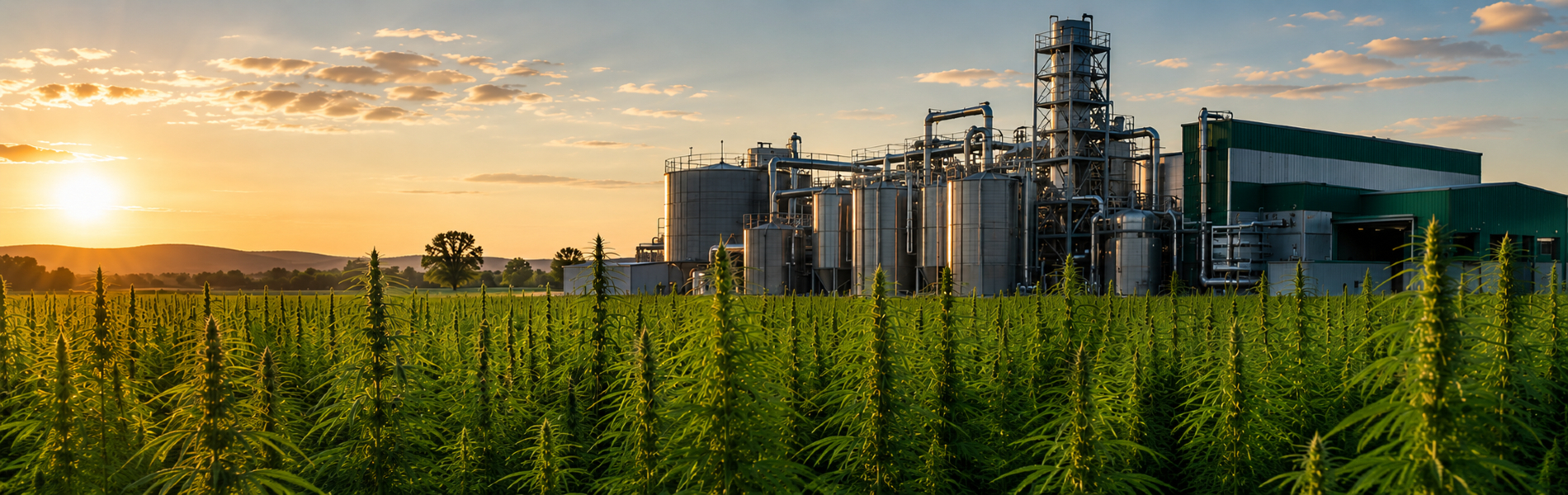
The same hemp plant can produce long fibers for textiles and composites, short fibers for insulation and paper, hurd for building materials and animal bedding, grain for food and feed, oils and proteins for nutritional products, and floral biomass for specialty markets.
What was once viewed as a commodity crop can now supply multiple industries from a single harvest.
The goal is no longer simply maximizing yield.
The goal is maximizing value.
The Rise of the Biorefinery
At the center of this transition is the biorefinery.
Much like petroleum refineries learned to maximize value from every barrel of oil, biorefineries seek to maximize value from every harvest.
Using mechanical, chemical, thermal, and biological processes, these facilities separate and process plant biomass into multiple streams of useful products.
Instead of one product and numerous waste streams, a biorefinery can generate multiple products from the same feedstock.
Fiber may enter textile and composite markets.
Cellulose may be used in packaging and paper.
Proteins may enter food and feed applications.
Natural compounds may support wellness, chemical, or specialty product markets.
Residual biomass may be converted into energy or other industrial products.
The idea is straightforward.
Waste less.
Use more.
Create additional revenue streams.
Keep more value within the supply chain.
As technology advances, biorefineries are becoming increasingly important pieces of the emerging bioeconomy.
New Revenue Streams for Farmers
For farmers, this is not simply about technology.
It is about economics.
Commodity agriculture often places farmers at the mercy of factors largely outside their control. Global supply, weather events, transportation costs, trade policies, and geopolitical developments can all influence prices.
Diversified processing systems create additional pathways to profitability.
Farmers may benefit from premium pricing for specific feedstocks, multi-year supply agreements, local processing partnerships, and access to markets that did not previously exist.
When a crop can serve multiple industries, the economic potential expands significantly.
A farmer is no longer selling only a commodity.
They are supplying a manufacturing system.
That distinction may become increasingly important as producers look for greater resilience and long-term stability.
Rural Communities Stand to Benefit
The benefits extend beyond the farm gate.
Processing facilities create jobs.
Manufacturing creates jobs.
Transportation creates jobs.
Engineering creates jobs.
Research creates jobs.
When processing occurs close to production, more economic activity remains within rural communities.
Historically, many agricultural regions exported raw commodities while much of the value-added processing took place elsewhere. The result was a steady transfer of economic activity away from the communities producing the resources.
The bioeconomy creates an opportunity to reverse that trend.
Biorefineries, fiber processing facilities, food manufacturing operations, and biomaterial production centers can help strengthen local economies while creating more resilient regional supply chains.
In the years ahead, rural economic development may depend as much on processing capacity as it does on agricultural production.
Infrastructure Remains the Challenge
Despite growing interest and innovation, significant challenges remain.
Processing infrastructure is still limited in many regions.
Capital remains difficult to access.
Supply chains continue to develop.
Regulatory frameworks continue to evolve.
Many promising technologies are still working their way toward commercial scale.
These challenges are not unique to hemp. They exist across much of the broader bioeconomy.
Building new industries takes time.
It requires investment, collaboration, education, and long-term commitment from both public and private stakeholders.
Still, progress is happening.
Around the world, companies, researchers, entrepreneurs, investors, farmers, and policymakers are working to develop the infrastructure needed to support this transition.
More projects are moving from concept to reality.
A New Role for Agriculture
For much of human history, agriculture has been viewed primarily as the foundation of food production.
That role remains essential.
But agriculture is increasingly becoming something more.
A source of renewable materials.
A source of industrial feedstocks.
A source of energy.
A source of manufacturing inputs.
A source of innovation.
The crops growing in fields today may ultimately supply many of the products used in homes, vehicles, buildings, packaging, consumer goods, and industrial applications tomorrow.
This is one of the central ideas behind The New Natural Economy.
No single crop will build the bioeconomy.
No single company will build it either.
Success will come from connecting farmers, processors, manufacturers, researchers, investors, and policymakers into functioning supply chains.
The goal is not simply to grow more biomass.
The goal is to create more useful products, stronger businesses, and healthier rural economies from the resources we already produce.
Agriculture has always fed the world.
The next chapter may be about much more than food.
The crops growing in our fields are increasingly becoming feedstocks for materials, products, energy, and manufacturing.
That’s not a future scenario.
It’s already happening.
