
By: RootSource Media,
For several days in September, New York became a meeting point for a global industrial hemp sector increasingly focused on moving beyond potential and into markets.
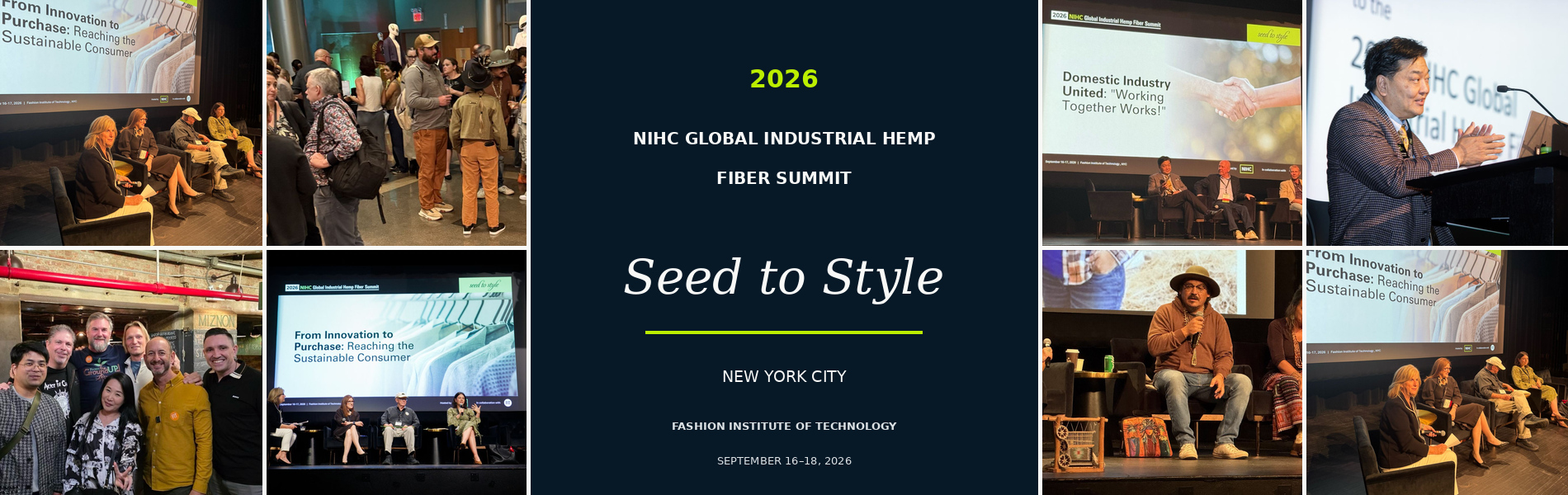
The 2026 NIHC Global Industrial Hemp Fiber Summit, held September 16–18 at the Fashion Institute of Technology (FIT) in New York City, brought together more than 50 speakers from agriculture, fiber processing, textiles, fashion, research, government, manufacturing, investment and hemp organizations around the world.
Under the theme “Seed to Style,” the Summit followed hemp from genetics and farming through processing, materials, textiles and finished products. An accompanying exhibition brought companies, organizations, materials and products onto the floor, giving attendees a chance to see and handle some of what was being discussed on stage.
The event was supported by companies and organizations across the hemp and natural fiber sectors, led by Platinum Sponsor 1937 International Corp. and Gold Sponsor Tuscarora Mills. Additional supporters included Fashion Institute of Technology, Bio-Smart Group, The Hemp Plastic Company, FIHO, AIHF, IND HEMP, Bear Fiber, Print On Hemp, USDA Agricultural Marketing Service, USDA Agricultural Research Service, USDA Foreign Agricultural Service, Wisconsin Crop Innovation Center, Cornell University College of Agriculture and Life Sciences, RootSource Media, Cait Curley Media and Choose Your Change.
Another phrase surfaced repeatedly over the two days:
Working Together Works.
That idea ran through much of the program, from domestic policy and international trade to research, processing, materials and fashion.
Beyond Hemp Talking to Hemp
One of the strengths of the Summit was the range of people involved. The program deliberately reached outside the traditional hemp conference circuit.
Shannon Maher, Dean of FIT’s Jay and Patty Baker School of Business and Technology, joined NIHC President and CEO Patrick Atagi in opening the Summit. Paul Benhaim of Bio-Smart Group and The Hemp Plastic Company helped emcee the event, introducing speakers and guiding the program across the two days. Benhaim also opened Day Two with a keynote and moderated sessions during the Summit.
Benhaim brought nearly three decades of experience in hemp foods, cannabinoids, plastics, materials and international market development. His presence also reflected the global character of the gathering, with participants arriving from Europe, Asia, Australia, Africa, Latin America and across North America.
The program extended well beyond hemp. Buxton Midyette of Supima Cotton and representatives of the flax sector joined hemp leaders in discussing the future of natural fibers. Researchers from Cornell University, Oregon State University’s Global Hemp Innovation Center, the University of Kentucky and federal programs contributed science and data. USDA officials addressed genetics, germplasm, research, standards and market development.
Industrial hemp does not exist separately from cotton, flax, forestry, plastics, construction materials or other agricultural commodities. Those sectors may compete in some applications, but they can also share processing technologies, manufacturing infrastructure, research and customers.
The session “Fiber Futures: Flax, Cotton & Hemp” explored where natural fiber sectors can work together on blends, processing and product development.
Hemp does not have to replace existing materials to become a meaningful global commodity. It has to establish where it performs well, where it complements other fibers and where buyers have a reason to use it.
From Innovation to Purchase
That question came into sharper focus during “From Innovation to Purchase: Reaching the Sustainable Consumer,” which brought the discussion downstream toward manufacturers, brands, investors and consumers.
Among the panelists was Ally Friedman, Program Officer for Energy and Industry at the Bezos Earth Fund. Her participation brought a perspective rarely represented at hemp conferences: how emerging materials fit into the much larger conversation around industrial decarbonization, manufacturing and investment. The Summit listed Friedman among its featured speakers alongside leaders from government, academia, agriculture and industry.
The session examined the difficult stretch between developing a promising material and getting it into products people actually buy.
For hemp, sustainability may open the door, but it cannot carry a product by itself. Manufacturers need materials that perform consistently. Brands need dependable supply. Products have to meet specifications and price targets. Consumers ultimately need a reason to choose them.
That makes scale, infrastructure and manufacturing just as important as environmental credentials.
The Bezos Earth Fund’s presence at FIT was notable for another reason. It placed hemp within a much larger materials conversation rather than treating it as its own isolated category. Hemp fiber, bioplastics and composites are competing and working alongside other materials in industries already under pressure to reduce emissions and rethink sourcing.
The question is no longer simply whether hemp can be made into something. The more useful question is whether it can be made consistently, competitively and at the scale required by commercial buyers.
From Potential to Infrastructure
There was considerably less interest at this Summit in declaring hemp a miracle crop.
Discussions centered instead on the practical requirements of commercial growth: equipment, processing capacity, reliable supply, standards, economics and buyers.
Sessions covered genetics and agricultural research, processing technology, infrastructure, supply-chain development, data and verification, biocomposites, bioplastics, nonwovens and textiles.
“From Field to Fiber” brought together Cretes, FRD-CODEM, Hemp Traders/Pure Fiber Innovations and the Hemp Feed Coalition to examine the equipment and infrastructure required to move hemp from farms into commercial production.
Another discussion moved further downstream into biocomposites, bioplastics and nonwovens, with IND HEMP, Americhanvre Cast Hemp, HempWood and The Hemp Plastic Company represented.
Growing more hemp does little good without somewhere for it to go. Commercial development requires enough acreage to support processors, enough processing capacity to supply manufacturers and enough demand to justify both.
Getting those pieces aligned remains one of hemp’s central challenges.
Government, Research and Standards
The federal government had a substantial presence at FIT.
Representatives from USDA’s Agricultural Research Service and Agricultural Marketing Service discussed federal hemp research, germplasm development, genetics, regulation, data and programs supporting commercialization.
Researchers from Cornell, Oregon State, the University of Kentucky and other institutions added work on agronomy, economics, materials and genetics.
NIHC also presented its developing NIHC Verify and NIHC Pulse initiatives, focused on data, verification and transparency.
These subjects may not attract the attention of hemp fashion on a runway, but they are basic requirements for building reliable markets.
Buyers need to know what they are purchasing. Manufacturers need predictable specifications. Farmers need reliable market information. International customers need confidence that products will meet requirements from one shipment to the next.
Domestic Industry United
The need for cooperation was front and center during “Domestic Industry United: Working Together Works!”
Moderated by Morris Beegle of Bio-Smart Group, the discussion brought together NIHC President Patrick Atagi, Kentucky Hemp Growers Co-op Association President Joe Hickey, Hemp Feed Coalition President Andrew Bish, U.S. Hemp Roundtable General Counsel Jonathan Miller and U.S. Hemp Building Association President Shawn Ledig.
It wasn’t an entirely comfortable conversation.
The panel had some fire to it, with candid exchanges over where hemp has been, where it needs to go and the priorities of its different sectors. Rather than smoothing over points of contention, panelists spoke openly about tensions that have existed within the business and the difficulty of finding common ground.
That candor made the session feel authentic.
Fiber, grain, food, feed, construction materials, cannabinoids and other applications do not face identical regulatory or commercial challenges. The organizations representing them aren’t going to agree on every issue, nor should anyone expect them to.
The more useful question is whether those differences prevent cooperation where interests do align.
At FIT, the answer was largely about staying engaged. There is room for spirited disagreement while still working together on research, market development, education, federal policy and establishing hemp as a viable American agricultural commodity.
In that sense, “Working Together Works” wasn’t about everyone agreeing. It was about staying at the table when they don’t.
Connecting the Global Hemp Industry
The discussion expanded internationally on the second day.
“International Industry United: Working Together Works!”, also moderated by Beegle, included Atagi; Dydy Leyson, Secretary-General of the Asia International Hemp Federation; Ted Haney, Board Chair of the Federation of Hemp Organizations; Dr. Zorodzai J.T. Maroveke of the Zimbabwe Industrial Hemp Trust; Sergiy Kovalenkov of the Ukrainian Hemp Building Association; and project management consultant Raymond Zvavanyange.
Europe brings decades of fiber knowledge and processing experience. China and other parts of Asia have substantial textile and manufacturing capacity. Australia has developed important hemp food markets. North America continues to expand processing and manufacturing, while Africa and Latin America are developing production models and commercial pathways of their own.
The conversation looked at how those regional strengths can complement one another through knowledge sharing, trade and international partnerships.
AIHF Secretary-General Dydy Leyson brought an Asian perspective to the panel, while hemp materials and textile work from Thailand and Japan offered examples of research, craftsmanship and product development underway across the region.
Participants from Australia, Pakistan, Ukraine, France and other markets further reflected the international scope of the Summit.
Latin America Enters the Conversation
Latin America’s emerging role received its own discussion in “Latin American Opportunities: Rebuilding an American Fiber from Genetics to Textiles.”
Moderated by Bear Fiber President Guy Carpenter, the panel included Morris Beegle, Davis Farms founder Jeremy Klettke and Sergiy Kovalenkov.
The session looked at a region with substantial agricultural capacity but an industrial hemp economy still early in its development.
Countries across Latin America are moving at different speeds on regulation, genetics, cultivation and processing. Argentina is developing new fiber production and seed multiplication activity, while markets across South and Central America are examining hemp for textiles, construction materials, food, feed and other applications.
The region also brings established agriculture, manufacturing capacity, varied growing climates and trade relationships. Connecting those assets with genetics, equipment, technical expertise and international buyers could help create regional production networks rather than a collection of isolated national markets.
Hemp, Heritage and Indigenous Leadership
“Hemp, Heritage & the Future: Indigenous Leadership in a Sustainable World” brought a different perspective to the program.
Moderated by Agriculture Policy Solutions Director Hunter Buffington, the session featured Winona LaDuke of the Indigenous Hemp Cooperative and Ira Vandever of Turquoise Indigo Fibers and the PDL Living Heritage and Resilience Hub.
The conversation covered Indigenous knowledge, agriculture, textiles, land stewardship and economic development alongside modern hemp production.
Natural fibers are not new technology simply because contemporary manufacturers have rediscovered them. Cultures around the world have grown, processed and used plant fibers within agricultural and textile systems developed over generations.
That knowledge remains relevant as hemp finds new applications in modern materials and manufacturing.
From Fiber to Fashion
Holding the Summit at FIT put hemp directly in front of students, designers and future textile professionals.
Hemp fabrics, garments and materials were visible throughout the event, culminating Thursday evening with a reception and fashion showcase.
The final program, “Concept to Catwalk: The Multifaceted Luxury of Hemp,” connected traditional hemp craftsmanship with contemporary design and premium textile applications. The discussion ranged from Japan’s refined hemp traditions to modern fashion, branding and material innovation.
Farmers and processors can produce excellent fiber, but manufacturers, designers and consumers ultimately determine whether it finds a market.
Bringing hemp to FIT connected the agricultural and processing side of the business directly with people who may eventually specify it, design with it and buy it.
Farm to Fabric Across New York
The hemp conversation continued after the NIHC Summit through the Farm-to-Fabric Hemp Textile & Fashion Symposium, presented by Choose Your Change as part of New York Textile Month from September 18–20, with support from NIHC.
At the Brooklyn Peace Center, farmers, Indigenous knowledge holders, researchers, textile specialists, artists, manufacturers and designers explored the progression from agriculture through fiber processing, textiles, art and finished products.
Live demonstrations included participation from the Tuscarora Nation, KINGDOM/weavearth and NC State’s Wilson College of Textiles, giving attendees a chance to see fiber and textile development firsthand.
Contemporary art was represented through RAW — INK ON HEMP, featuring works by artist Marie Pervenche created directly on raw hemp textile.
The weekend moved to Governors Island on September 20 for a fashion presentation and the official release of a special hemp-focused issue of Julian Magazine.
The Julian Hemp Issue documents people, companies, artists, designers and projects participating in the farm-to-fabric movement. The accompanying fashion presentation showed finished hemp and hemp-blend garments along with the farms, fibers, mills, makers and designers behind them.
Together, the FIT Summit and Farm-to-Fabric events followed hemp from agriculture and research through machinery, trade, textiles, art and fashion over several days in New York.
A Global Industry Still Being Built
The structural challenges facing industrial hemp remain substantial.
Processing capacity is uneven. Supply chains are fragmented. Regulations vary widely between countries and applications. Manufacturers need consistency and scale, while farmers need dependable markets before committing acreage.
Those challenges were discussed openly in New York alongside signs of progress.
Companies are expanding processing. Researchers are improving genetics and agronomic knowledge. Government agencies are supporting research, germplasm and data. Manufacturers are testing materials. Textile companies are working with blends. Designers are putting hemp into finished products. International relationships are opening new channels for knowledge and trade.
The 2026 NIHC Global Industrial Hemp Fiber Summit put many of those pieces under one roof.
No single company, association, country or application is going to carry industrial hemp into the mainstream. Farmers need processors. Processors need manufacturers. Manufacturers need brands and buyers. Researchers need commercial partners. Governments need reliable data. International markets need trade relationships.
From the fields where hemp begins to the FIT runway where finished garments appeared, “Seed to Style” captured what the sector is trying to accomplish: connecting those pieces well enough to build a functioning global marketplace.
