By: RootSource Media Staff,
As the scale of global waste continues to mount, a quiet revolution is underway. Designers, entrepreneurs, and scientists are reimagining waste as raw material. In the emerging circular bioeconomy, biological residues and side streams once destined for landfills or incinerators are being transformed into compostable packaging, biomaterials, energy, and high-value chemicals. This shift from linear to circular systems promises to reduce pollution, strengthen rural economies, and align human industry with natural cycles.
The Promise of Circularity in the Bioeconomy
A linear economy built on “take, make, waste” drains resources and creates mounting environmental burdens. By contrast, a circular bioeconomy emphasizes reduce, recycle, reuse, recover, and regenerate—closing loops so that outputs become inputs again, as described in a 2024 Nature study.
At its heart lies the principle that biomass, residues, and by-products should not be discarded but reintroduced into new value chains. Through cascading use, materials can first become high-value products, then nutrients or energy, and ultimately reintegrate safely into ecosystems, according to research in Biotechnology for Biofuels.
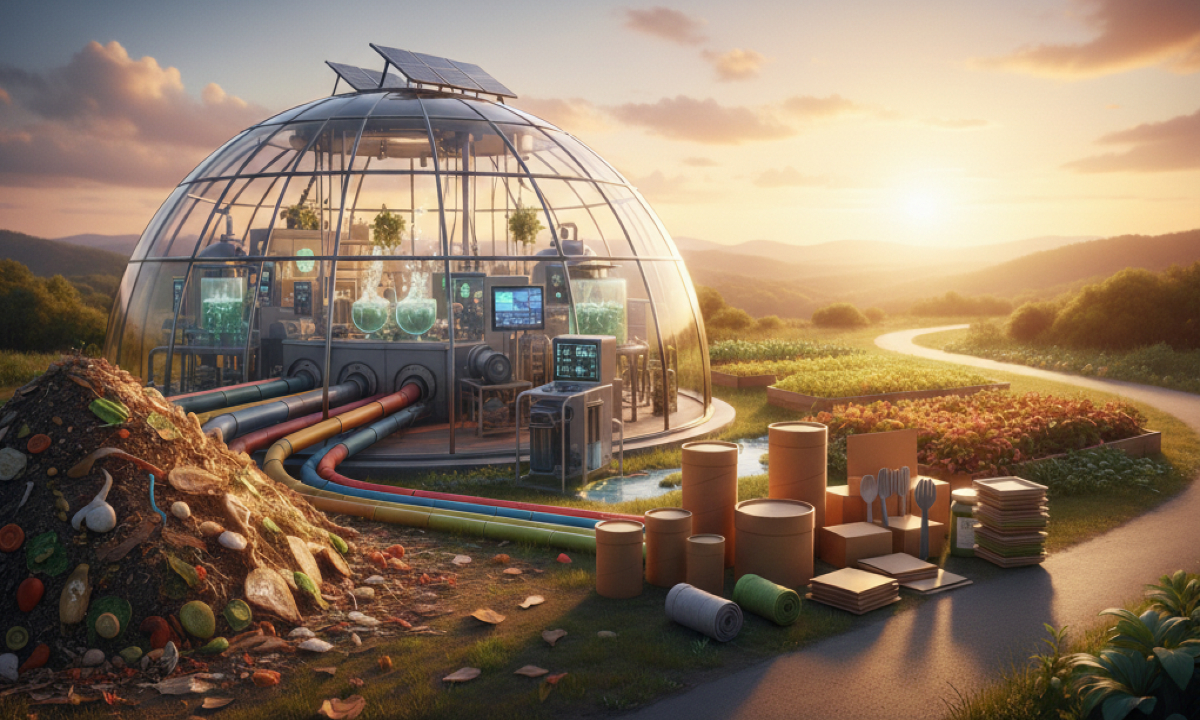
One major strategy is the waste biorefinery, which converts agricultural residues, food processing by-products, or organic waste into multiple outputs such as biofuels, biopolymers, and biomolecules. These facilities also treat wastewater and minimize emissions, tightening the loop on carbon, nutrients, and water while delivering both environmental and economic benefits.
Circular design in natural industries is not simply a matter of switching inputs. It requires systems thinking, local infrastructure, fair incentive structures, and collaboration across sectors.
Innovations in Compostable Packaging and Biomaterials
One of the most visible frontiers of circular design is in packaging and biomaterials, where plastic pollution is most severe. Several innovators are now building alternatives using mycelium, hemp, algae, and molded fiber composites derived from agricultural and paper waste.
Molded Fiber Packaging from Agricultural Residues
Molded fiber packaging is rapidly becoming one of the most scalable circular packaging solutions. Made from post-industrial paper waste, agricultural by-products, or cellulose pulp, these molded forms can replace single-use plastics in items such as clamshells, trays, drink carriers, and protective inserts. They are lightweight, recyclable, and often home-compostable, depending on additives and coatings.
Newer approaches integrate non-wood feedstocks—such as wheat straw, sugarcane bagasse, or hemp fiber—to reduce reliance on traditional pulpwood sources and further close material loops. A 2024 Packaging Europe report noted that molded fiber now accounts for over 10% of global sustainable packaging growth, with demand driven by foodservice bans on plastics and extended producer responsibility policies.
Industry leaders like Huhtamaki, PulPac, and Footprint are scaling molded fiber technology globally, offering durable, renewable packaging formats that align with circular design principles.
Mycelium and Hemp Hurd Packaging
Ecovative’s MycoComposite combines mycelial growth with hemp hurd to form molded packaging that is home-compostable in 45 days. It acts as a regenerative replacement for foam or polystyrene and is grown rather than manufactured, requiring minimal energy and no harsh chemicals.
Algae-Based Films
Startups like Sway produce seaweed-based wrappers and films that decompose in home compost or marine environments, harnessing the fast growth and polysaccharide content of marine biomass.
Mycelium Biocomposites for Interiors
Researchers are testing mycelial composites for panels, acoustic elements, and lightweight building blocks. These materials consume lignocellulosic wastes such as sawdust and crop residues, turning waste into structural solutions.
These examples embody the principle of designing for disassembly and biodegradability, ensuring a product’s end-of-life is considered from its inception.
Biorefineries Turning Residues into High-Value Outputs
Beyond packaging, circular systems are operating at regional and agricultural scales.
In California’s Central Valley, researchers are developing regional biomanufacturing hubs that convert millions of tons of crop residues into feedstocks for new bio-based products, according to a Lawrence Berkeley National Laboratory report.
In Croatia, corn residues and animal fats are being converted into glycerol, a versatile ingredient in cosmetics, food, and pharmaceuticals, through a project by VCG.AI.
Canada’s cleantech firm Enerkem transforms municipal solid waste and residual biomass into renewable chemicals and fuels such as ethanol and methanol.
In India, the startup Takachar uses small-scale torrefaction units to turn crop residues into biochar and biocoal, reducing open burning and creating decentralized energy solutions for farmers.
In Pennsylvania, a dairy farm is converting food and agricultural waste into biogas and fertilizer, meeting much of its own energy needs and returning nutrients to the soil, as profiled by the American Society of Agricultural and Biological Engineers.
Each of these examples demonstrates how agricultural by-products can be reimagined as renewable resources that sustain local economies.
Challenges to Scaling
Despite the promise of circular systems, scaling remains complex. Experts emphasize that technology alone cannot achieve full circularity without policy, markets, and community alignment, as noted by Nature.
Key barriers include:
- Economic trade-offs: Circular processes may involve higher upfront costs or longer payback periods. Balancing cost, environmental gain, and equity remains a challenge.
- Feedstock logistics: Collecting and processing bulky residues can be expensive and energy intensive.
- Evolving standards: Global benchmarks for compostability, biodegradability, and performance are still emerging.
- Consumer behavior: Sustainable materials must compete with cheap fossil-based products. Public procurement and regulation can help shift demand.
- Equity concerns: Transitions risk favoring large or well-connected players. Inclusive planning ensures benefits reach small producers and rural communities.
Solutions often combine research, policy incentives, decentralized supply chains, and partnerships that reward regenerative outcomes.
Building Local Circular Economies
Circular bioeconomy models thrive when rooted in place. Localized systems collect residues from nearby farms or food operations, process them into products, and return the benefits to local markets.
Core strategies include:
- Regional biohubs that aggregate and preprocess biomass for multiple users.
- Industrial symbiosis, such as locating a mushroom packaging facility near hemp growers to share inputs and outputs.
- Diversified outputs that spread risk across fuels, fertilizers, polymers, and fibers.
- Community partnerships linking farmers, waste managers, and businesses in transparent value-sharing systems.
- Circular procurement, where governments and corporations commit to buying regenerative materials.
These strategies shorten supply chains, lower emissions, and keep economic value within communities.
Looking Ahead
Circular design is no longer confined to sustainability reports or pilot projects. It is beginning to redefine industries and inspire collaboration between sectors that once operated in silos. Compostable materials, biorefineries, and waste-to-value startups are proving that waste can fuel a new generation of regenerative enterprise.
