By: RootSource Media Staff,
Some films feel like they were assembled in a conference room. Others feel like they were grown outdoors, slowly, with a few rough edges left on purpose. American Hemp Farmer is very clearly the second kind.
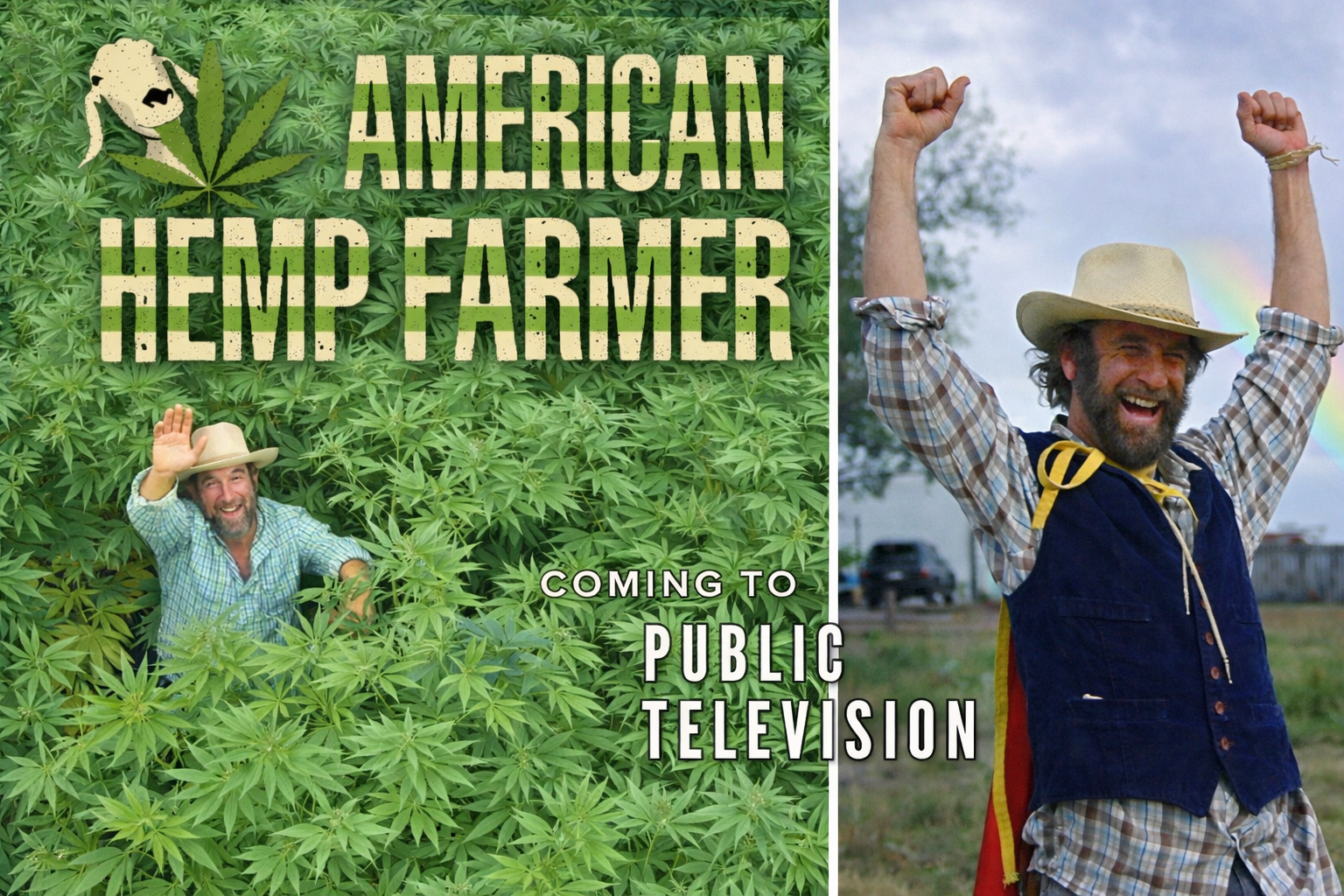
After years of filming in out-of-the-way hemp fields, revisiting old agricultural traditions, and sticking with a story that never fit neatly into trends or headlines, American Hemp Farmer is finally heading to public television nationwide. The film, written and directed by Doug Fine, has secured a three-year distribution deal with the National Educational Telecommunications Association (NETA) and will begin airing on PBS stations starting March 14. It will reach all 350 U.S. public media outlets, with streaming on PBS.org and the PBS app, and video-on-demand via DougFine.com.
It’s a meaningful milestone, but not a flashy one. More like the quiet satisfaction that comes when something you’ve worked on for years finally finds its audience.
The documentary is based on Doug’s bestselling book, but it doesn’t feel like a book adaptation. It feels like Doug on the road, following his curiosity and letting the camera tag along. He visits hemp farmers in Oregon and Vermont, works with a Tribal farming enterprise on Rosebud Sioux land, and even heads back to George Washington’s Mount Vernon to hand-harvest hemp with a scythe while dressed in colonial-era hemp clothing. This is not a metaphor. It actually happens.
There’s humor throughout, much of it unintentional, which is kind of Doug’s specialty. But the film is serious about what it’s trying to say. Regenerative hemp farming can rebuild soil, support farmers, and make agriculture more resilient in a time when extreme weather is becoming the norm. Hemp is not presented as a miracle cure, but as a tool we forgot how to use properly, and one worth taking seriously again.
The film has already resonated on the festival circuit. It won Best New Mexico Documentary at the Santa Fe Film Festival, where it premiered, and received the Audience Choice award at the Silver City Film Festival. It was also an official selection at the Las Cruces International Film Festival. Audience reactions during Q&As have been emotional, curious, and very direct. People want to know where they can see it and what they can do next.
There’s also a personal layer that runs through the film, even when it’s not front and center. During final editing, Doug and his family were forced to evacuate their Funky Butte Ranch in New Mexico due to wildfire threats, something they’ve faced multiple times in recent years. Goats and chickens had to be relocated on short notice. The experience was stressful, disorienting, and far from hypothetical. Climate change, in Doug’s world, is not an abstract concept. It shows up at the front gate.
That experience sharpened the film’s tone. American Hemp Farmer isn’t alarmist, but it doesn’t sugarcoat reality either. It makes the case that rebuilding soil and changing how we farm is not about ideology. It’s about whether farmland remains usable at all.
At the same time, the film avoids the trap of suggesting everyone needs to drop everything and become a farmer. Doug’s approach is more practical than that. Grow something if you can. Support people who do. Pay attention to where your food comes from. Small actions add up, especially when enough people take them seriously.
That perspective will carry into March when Doug Fine appears at IHI – Industrial Hemp International, taking place March 25–27, 2026, in Denver. Doug will be speaking about American Hemp Farmer and the broader lessons behind it at a moment when the hemp industry is once again trying to sort itself out.
IHI is produced by Morris Beegle, and Doug’s presence there is not a coincidence. Morris and Doug go back to the very early days of the modern hemp movement. They became friends before Hemp Bound was released, at the very first NoCo Hemp Expo, when the industry was still small enough that everyone knew each other and nobody was pretending this was easy.
Doug went on to participate in many NoCo Hemp Expos, Southern Hemp Expos, and other hemp related events over the years. They shared stages, late-night conversations, long drives, and the occasional moment of wondering whether the rest of the world was ever going to catch up. That shared history shows up in the film, even indirectly. American Hemp Farmer comes from the same place those early events did: a stubborn belief in the plant, a sense of humor about the chaos, and a willingness to keep going even when progress felt slow.
As the film begins airing on public television this spring, it arrives at a time when conversations about agriculture, climate, and resilience are louder than ever, but not always clearer. American Hemp Farmer doesn’t try to solve everything. It tells a grounded story about what is possible, what has been forgotten, and what might still be rebuilt.
It’s funny in places. It’s uncomfortable in others. And it feels honest in a way that’s increasingly rare. Like Doug himself. Like hemp, when it’s allowed to be more than a buzzword.
