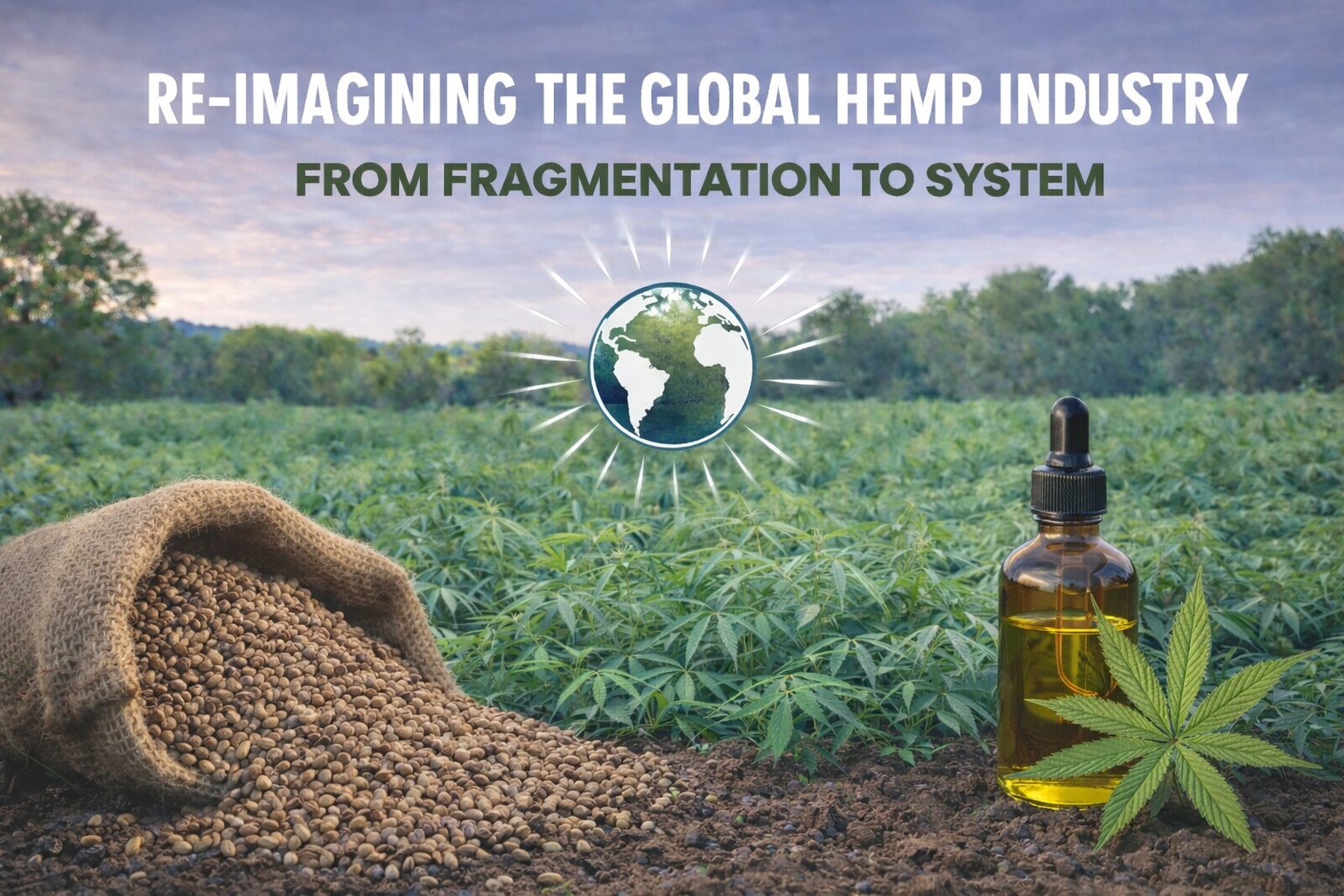
From Fragmentation to System
Re-Imagining the Global Hemp Industry
A conversation between Morris Beegle and Paul Benhaim
Introduction
Hemp is often described as a miracle crop, yet across continents and decades, the industry continues to struggle with fragmentation, stalled projects, and failed scale attempts. The issue, according to Paul Benhaim, has never been the plant itself.
Paul has spent decades building real hemp businesses across food, materials, and industrial applications. His perspective is not theoretical. It is operational.
In this conversation, we step back from hype cycles and dig into a harder question. What does it actually take to make hemp work at scale?
Hemp at a Turning Point
MORRIS:
Paul, I’ve watched you work in hemp for decades, not just as an advocate but as someone who builds businesses that last. Hemp is one of humanity’s oldest crops, yet it still feels like an industry that hasn’t fully found its footing. Where are we in the global hemp story right now?
PAUL:
We are at an inflection point. Hemp has survived suppression, misunderstanding, and fragmentation. What is changing now is the shift from hemp as a cause to hemp as infrastructure.
The opportunity today is not about proving hemp works. We already know it does. The real work is designing the system properly so it can scale.
Hemp doesn’t fail because the plant doesn’t work. It fails because the system around it is incomplete.
Learning From History
MORRIS:
I’ve spent years documenting hemp’s cultural and industrial roots. Historically, hemp was not a niche crop. It was foundational. How important is that context when we talk about the future?
PAUL:
It is essential. Hemp was never meant to be a single-use crop. For thousands of years it was food, fibre, building material, and medicine at the same time.
The mistake modern industries make is trying to force hemp into one narrow lane instead of respecting its natural role as a multi-output system.
When societies grew hemp historically, everything had a use. Nothing was wasted. That is the lesson we need to re-learn.
Why Modern Hemp Projects Struggle
MORRIS:
Despite all the enthusiasm, we have seen many hemp projects stall or collapse. Why does this keep happening?
PAUL:
Because most projects are built backwards.
Someone starts farming without secured processing.
Someone builds processing without guaranteed offtake.
Someone launches a product without supply consistency.
Each piece might work on its own, but without coordination, the entire system becomes fragile.
It is not a hemp problem. It is a systems problem.
Hemp exposes poor system design faster than most industries because margins are tight and logistics matter.
The Role of Food as a Foundation
MORRIS:
You have worked across food, nutrition, materials, and industrial applications. How did that shape your view of what hemp needs to succeed?
PAUL:
Hemp food taught me discipline.
Hemp seed is a staple product. It is non-intoxicating, nutritionally dense, and globally accepted. When you build businesses around hulling, oil pressing, and protein production, you learn supply chains, quality control, scale, and margins.
Food creates stability. It creates farmer confidence. It creates jobs quickly.
Once that foundation is in place, fibre and hurd open doors to construction, insulation, animal bedding, and industrial materials. From there, hemp-filled plastics and composites unlock serious industrial demand.
What Is Missing
MORRIS:
You often say the industry does not lack passion or technology, but rather a plan. What do you mean by that?
PAUL:
What is missing is a plan for the hemp industry, not just individual hemp businesses.
That means designing an integrated model that includes genetics, agronomy, farming systems, primary processing, food production, building materials, and industrial materials.
Each of these can operate independently, but when they are designed together from the beginning, they reinforce each other economically.
One crop. Multiple revenue engines. Shared infrastructure. That is how you de-risk hemp.
Climate Reality, Not Symbolism
MORRIS:
Hemp is often framed as a climate solution. How do you think about that in practical terms?
PAUL:
Hemp’s real climate impact is not just carbon capture. It is carbon displacement.
When hemp replaces cement, plastics, insulation, or imported materials, emissions are reduced across entire supply chains.
The climate value shows up when hemp is embedded into industrial systems, not when it is treated as a symbolic green crop.
That distinction matters to governments, investors, and manufacturers who care about execution, not slogans.
Jobs and Regional Economies
MORRIS:
Employment often gets overlooked in these conversations. What role does hemp play in regional development?
PAUL:
A major one.
Hemp creates work across the entire chain, from farming and logistics to food manufacturing, materials production, and construction.
Because it is decentralised, it supports regional economies rather than concentrating wealth in one place.
These are real jobs tied to real production, not speculation. That resilience is exactly what many regions are looking for as they rebuild local industry.
Scale and the Future
MORRIS:
When an integrated hemp model is done correctly, what does success actually look like?
PAUL:
If the system is coordinated, phased, and disciplined from the start, it can scale quickly. We are talking well beyond $100 million per model in projects we have designed at The Bio‑Smart Group.
This is not about one product line succeeding. It is about an entire hemp economy coming online, supported by infrastructure, trade, and global collaboration.
That is how you reach meaningful scale within five years, and why I believe this is the future of hemp.
Closing Thoughts
MORRIS:
If you could leave the global hemp community with one message, what would it be?
PAUL:
Stop thinking in fragments.
Hemp is not a trend. It is infrastructure.
When we design it properly, it can feed people, house people, employ people, and materially improve the planet.
MORRIS:
That is a strong place to end. Thanks for sharing the bigger picture.
Morris Beegle and Paul Benhaim work together through the Bio-Smart Group, advising governments, investors, and operators interested in building viable, full-system industrial hemp models based on decades of real-world experience. Learn more at www.thebiosmartgroup.com
