By: Morris Beegle,
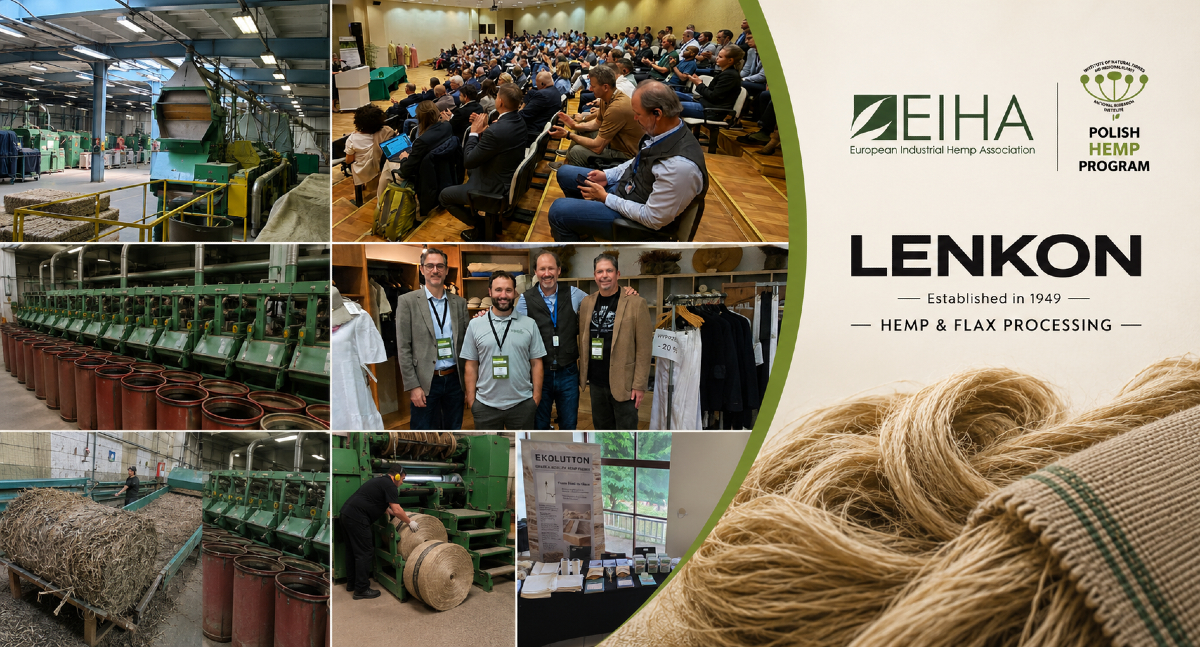
I recently returned from Poznań, Poland, where I attended the 23rd Annual European Industrial Hemp Association (EIHA) Conference hosted by the Institute of Natural Fibres and Medicinal Plants (IWNiRZ).
Having attended hemp conferences around the world for more than a decade, one thing stood out immediately in Poland. The conversations continue to evolve. A few years ago, much of the discussion at hemp events centered on potential and possibilities. In Poznań, much of the focus was on processing, manufacturing, infrastructure, market development, and the practical challenges of building successful businesses and supply chains.
The conference program reflected that reality. Sessions focused heavily on fiber processing, textiles, construction materials, bioplastics, carbon sequestration, food and feed applications, genetics, and industrial manufacturing. While cannabinoids remain part of the discussion, they represented a smaller portion of the agenda than in previous years. The emphasis was largely on industrial hemp and its role within a broader bioeconomy.
I had the opportunity to moderate the panel, Global Hemp Markets: Europe in the International Landscape, which brought together perspectives from France, Argentina, the United States, and international organizations. While every region faces its own unique challenges, many of the issues being discussed are remarkably similar. Processing infrastructure remains limited in many markets, capital remains difficult to access, and regulatory frameworks continue to evolve. At the same time, there is growing recognition that hemp can contribute to a range of industries including textiles, construction materials, food, feed, composites, and other bio-based products.
As part of my participation in the conference, I represented the National Industrial Hemp Council of America (NIHC), with travel support provided in part through a USDA Market Access Program (MAP) grant. International engagement remains an important component of building relationships between hemp stakeholders in the United States and key partners throughout Europe and other global markets.
The United States was well represented at the conference by participants from organizations and companies including IND HEMP, HempWood, Her Many Voices, Everyday Hemp, Whitney Economics, Lancaster Farming, TGH Enterprises, and others. Their presence reflected the growing interest among U.S. businesses and industry leaders in international collaboration, market development, processing technologies, genetics, sustainable materials, and supply chain opportunities.
Beyond the conference sessions, much of my time was spent meeting with industry leaders, policymakers, researchers, equipment manufacturers, and entrepreneurs. Discussions included hemp processing and machinery with CRETES, ANDRITZ, Tatham International, and TEMAFA, along with conversations involving European policymakers, bioplastics organizations, construction innovators, genetics programs, and emerging bioeconomy projects. These meetings often provide valuable insight into where investment, innovation, and collaboration are taking place across the industry.
One of the highlights of the trip was a visit to the Lenkon processing facility outside Poznań with Witold Czeszak and the Polish Hemp Program team. Lenkon is a historic flax and hemp processing facility that is undergoing revitalization and modernization. The machinery was certainly interesting, but what stood out most was the workforce. Some of the operators and technicians have spent 20, 30, and even 40 years working in fiber processing. In a world where many regions are trying to rebuild hemp processing capacity, that kind of experience and technical knowledge is difficult to replace.
I also spent considerable time with leaders from the Polish Hemp Program and the Institute of Natural Fibres and Medicinal Plants. Poland continues to play an important role in hemp genetics, seed development, cultivation research, and processing innovation. Their work extends well beyond Europe, with genetics and expertise being utilized in markets across North America, South America, and Asia. As hemp industries continue to develop globally, these international relationships become increasingly important.
Another theme that emerged throughout the conference was the growing role of Central and Eastern Europe. Poland, Ukraine, the Czech Republic, and neighboring countries are attracting increased attention as centers for cultivation, processing, manufacturing, and industrial development. Several discussions highlighted both the opportunities and challenges facing the region as investment and market demand continue to grow.
Perhaps the most encouraging aspect of the conference was the practical nature of many of the discussions. Rather than debating whether hemp has potential, participants were focused on solving real-world challenges related to processing, manufacturing, market development, standards, commercialization, and investment. That is a healthy sign for an industry that continues to mature.
I would like to extend my sincere thanks to Witold Czeszak, the Polish Hemp Program, and the entire team at the Institute of Natural Fibres and Medicinal Plants for hosting an outstanding event. Their hard work, professionalism, and commitment to advancing the hemp sector were evident throughout the conference. Thank you as well to the EIHA staff, board members, speakers, sponsors, exhibitors, volunteers, and attendees who helped make the conference a success. Bringing together leaders from across the hemp value chain is no small undertaking, and the result was a productive gathering for the international hemp community.
The conversations in Poland reinforced something I have believed for many years. Hemp is not a single market or a single industry. Its future will be built through connections between agriculture, processing, manufacturing, research, policy, and market development. The work being done in Poland and across Europe offers valuable lessons and opportunities for stakeholders around the world, and I look forward to continuing many of the conversations that began in Poznań.
